

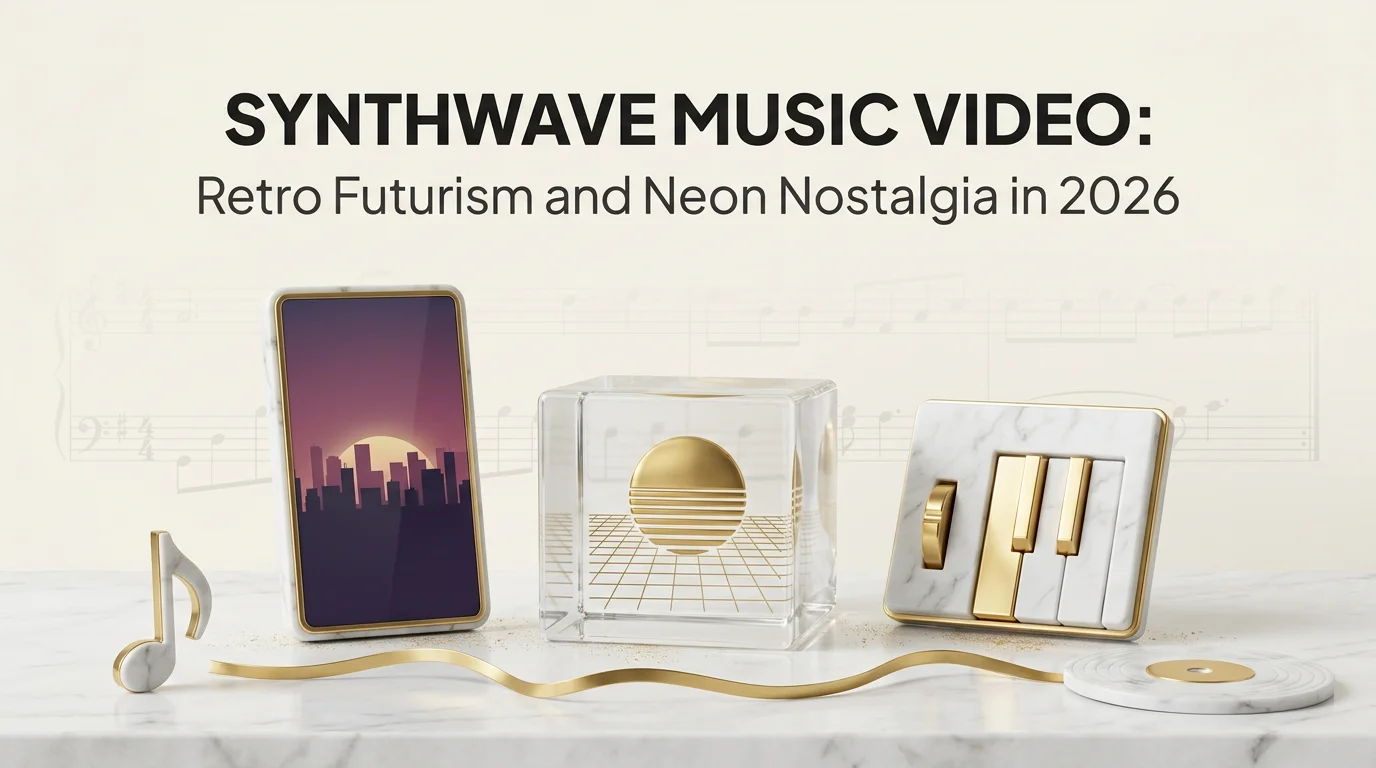
A synthwave music video is the visual half of a genre that built its entire identity around imagining the future as it was imagined in 1984. The aesthetic is highly codified: neon grid horizons, palm tree silhouettes against magenta sunsets, chrome-and-CRT typography, low-poly mountains, retro sports cars, VHS scan lines, and characters in jackets that fit a Miami Vice or Drive (2011) frame of reference. For an artist working in synthwave, the visual codes are not optional decoration; they are the genre.
The shortest path to a synthwave music video: pick a sub-style (outrun, retrowave, darksynth, dreamwave), write a creative direction that names the sub-style with specific visual codes, pick a synthwave-matching style preset, and generate a first draft in the ratio you need (9:16, 16:9 or 1:1). The rest of this guide covers what makes each sub-style distinct, the visual codes that hold the genre together, and how to produce the aesthetic for your own track without sourcing every reference manually.
Key Takeaways
- Synthwave is one of the most visually codified music genres of the past decade. The aesthetic is rigid in a way that helps because the codes are specific.
- The genre has sub-styles (outrun, retrowave, darksynth, dreamwave) that map to different song moods. Picking one tightens the visual direction.
- The load-bearing codes: neon grid horizons, sunset gradient palettes (magenta to orange to deep purple), retro-tech objects (CRT screens, cassettes, chrome sports cars, VHS artifacts), 1980s typography, low-poly mountain silhouettes, palm trees.
- Synthwave videos do not need realistic characters. The aesthetic supports stylized, semi-abstract, or even character-less videos better than most genres.
- AI generation suits synthwave especially well because the codes are graphic and codified rather than dependent on naturalistic detail.
The Synthwave Visual Language: Codes That Define the Genre
Synthwave borrows from a specific imagined 1980s: the look of films like Drive, Blade Runner, and Tron, plus the imagined version of Miami the genre inherited from Vice City and Miami Vice. Six visual codes hold the genre together.
The neon grid horizon. The single most identifiable synthwave image. A grid of glowing lines stretching toward a vanishing point at the horizon, with the lines suggesting a vast plane fading into infinity. Often paired with a sun or moon at the horizon's center.
Sunset gradient palettes. Magenta to orange to deep purple, or hot pink to electric blue to black. The gradient is usually a single dominant element of the frame, not a small accent. Synthwave is a high-saturation genre.
Retro-tech objects. CRT television screens, cassette tapes, VHS tapes, old computer terminals, dot-matrix printers, neon-trimmed jukeboxes. These objects function as period anchors. A character interacting with a CRT instantly reads as synthwave; the same character interacting with a smartphone breaks the genre.
Chrome-and-CRT typography. Specific 1980s display fonts (Eurostile, Compacta, custom chrome lettering, neon-tube fonts). Modern sans-serif typefaces feel out of period.
Low-poly mountains and palm trees. Geometric simplified silhouettes against the sunset. Real photographic mountains feel naturalistic; low-poly stylized versions read as the genre's intended retro-CGI aesthetic.
VHS artifacts and scan lines. Subtle horizontal scan lines, occasional tracking glitches, chromatic aberration on edges. These signal the analog-video heritage even when the content is digital.
Hit four or more of these together and the video reads as synthwave. Hit one or two and it reads as "moody electronic with some neon".
The Four Synthwave Sub-Styles
"Synthwave" is the umbrella. The sub-styles inside it have distinct aesthetic centers.
Outrun (high-energy, driving)
Sports cars on highways at sunset. Speed, motion, palm trees blurring past, neon trim on a Lamborghini Countach silhouette. Maps to high-BPM driving tracks. References: Kavinsky, The Midnight, Gunship.
Retrowave (broader, more anthem-feeling)
The full synthwave palette without the specific driving narrative. Cityscapes, neon skylines, characters in 80s fashion, broader emotional range. Maps to anthemic and melodic synthwave tracks. References: Timecop1983, FM-84, The Midnight again (they cross styles).
Darksynth (heavier, more horror-adjacent)
Cold palette shift: less hot pink, more deep purple and black, occasional blood red. Industrial machinery, abandoned buildings, neon-lit corridors with threat in them. Maps to darker electronic tracks with horror or action film influence. References: Perturbator, Carpenter Brut, GosT.
Dreamwave (softer, more atmospheric)
Hazier, less defined. Pastel pinks and soft purples, foggy horizons, abstract visuals over recognizable scenes. Less direct retro-tech references. Maps to softer ambient synthwave and lo-fi influenced tracks. References: HOME, Yung Bae.
Pick one. Mixing two without intent produces a video that reads as undefined; mixing with intent (darksynth-influenced retrowave for a horror-action song) works when the music supports the hybrid.
Producing a Synthwave Music Video From Your Song
The workflow:
- Pick the sub-style. Outrun, retrowave, darksynth, or dreamwave.
- Write the creative direction. Two paragraphs naming the sub-style and the specific codes. Example for outrun: "Outrun synthwave aesthetic. Neon grid horizon dominant in most shots. Sports car silhouette (chrome-trimmed, fictional 80s-style) racing through a desert highway at sunset. Magenta-to-purple gradient sky with the sun a perfect circle at the horizon. Palm tree silhouettes flanking the road. VHS scan lines and slight chromatic aberration at the edges. Low-poly mountain silhouettes in the far distance."
- Pick the matching style preset. In Echonos Engine, the retro-leaning presets carry the aesthetic load: Vaporwave Chrome, Retro Open World, Cyberpunk, Low-Poly PS1 and Y2K Glossy are natural starting points.
- Upload your song. MP3, M4A, WAV, AAC, OGG, or FLAC, up to 40 MB, 60 second minimum.
- Generate the first draft in the ratio you need (9:16, 16:9 or 1:1). Each run renders a 10 to 30 second moment of the song you pick, in minutes, not hours.
- Iterate on the codes that drifted. Synthwave is detail-sensitive; if the grid horizon disappears in three scenes or the sunset palette shifts toward naturalistic gold, run that moment again with the codes called out explicitly in the creative direction.
The music video in 5 minutes walkthrough covers the end-to-end engine flow. The prompt writing guide covers iteration patterns for specific scenes.
Why Synthwave Works So Well With AI Music Video Generation
Most genres punish AI music video work when the model drifts on naturalistic detail. Synthwave is the opposite: the aesthetic was already stylized, graphic, and codified. It does not need photorealism. It needs the codes.
The result: synthwave is one of the most reliably executable genres for AI music video work. The same model that struggles to maintain a consistent realistic human face across 12 scenes can maintain consistent neon grid horizons, sunset palettes, and stylized retro-tech objects across the same 12 scenes without issue.
If your song is synthwave or synthwave-adjacent and you are testing AI music video generation, this is a low-friction genre to start with.
Common Synthwave Music Video Mistakes
Modern objects in frame. A character with a smartphone, a modern car, current-day cityscape elements. Break the period anchor and the video stops reading as synthwave.
Naturalistic sunset. A real photographic golden-hour sunset is not synthwave. The genre wants the saturated magenta-to-purple gradient that exaggerates the sunset into a poster.
Skipping the grid horizon. It is the most identifiable synthwave element. A video without one can still read as the genre, but it is fighting the genre's strongest single visual signal.
Mixed-decade fashion. Characters in 90s grunge clothing or contemporary streetwear pull the video out of the 80s frame. Synthwave's character wardrobe sits firmly in 1980s revival: leather jackets, neon trims, sunglasses, asymmetric haircuts.
Generic synth-pop visuals branded as synthwave. Mid-tempo electronic over generic city visuals is not synthwave just because the genre name is in the title. The visual codes have to be specific.
Synthwave Music Video Specs for Release
Same vertical short-form specs as any music release.
- 9:16 vertical, 1080 by 1920 for the master and short-form cuts.
- 15 to 30 seconds for cut-downs. Synthwave's high visual density rewards slightly longer watches but does not benefit from over-60-second cuts.
- Hook in the first 3 seconds. Lead with the most synthwave-readable frame (sunset gradient with the neon grid, the chrome car silhouette, a character framed against the gradient sky).
- 16:9 horizontal for the YouTube main page if synthwave-fan YouTube is a primary distribution target. The genre's audience leans heavily on the YouTube channel ecosystem (NewRetroWave, Aim to Head, others), so a horizontal version often matters more in synthwave than in pure short-form genres.
The music video aspect ratio guide covers the full ratio table.
The Read on Synthwave Music Videos
Synthwave is a codified genre with sharp visual rules. Hitting four or more of the load-bearing codes (neon grid, sunset gradient, retro-tech, retro typography, low-poly mountains, VHS artifacts) reads as the genre. Picking a sub-style (outrun, retrowave, darksynth, dreamwave) tightens the direction. The genre's stylized nature makes it especially well-suited to AI music video generation because the codes are graphic rather than naturalistic.
If you have a synthwave track and want the video to come together fast, Echonos Engine accepts the sub-style-specific creative direction and produces a first draft in 9:16, 16:9 or 1:1 in minutes, not hours, with the consistency tooling needed to keep the genre codes stable across every scene.
FAQ
Frequently Asked Questions
5 questions answered. Tap to expand.
What is the difference between synthwave, retrowave, and outrun?
What is the difference between synthwave, retrowave, and outrun?
Synthwave is the umbrella genre. Retrowave is the broader synthwave aesthetic without a specific narrative focus. Outrun is the synthwave sub-style centered on sports cars, highways, and driving narratives. Darksynth is the heavier horror-adjacent sub-style. Dreamwave is the softer atmospheric sub-style. Most fans use the terms with some overlap; for music video direction, picking the specific sub-style produces sharper results than using "synthwave" alone.
Can I make a synthwave music video with AI?
Can I make a synthwave music video with AI?
Yes, and synthwave is one of the most reliable genres for AI music video work because the aesthetic is highly codified and graphic rather than dependent on naturalistic detail. AI generators maintain neon grids, sunset palettes, and retro-tech objects across scenes more consistently than they maintain realistic human faces in the same conditions.
What colors are used in synthwave music videos?
What colors are used in synthwave music videos?
Hot magenta, electric pink, deep purple, neon blue, occasional orange (for the sun at the horizon). Backgrounds are dark to make the neon read. The palette is high-saturation and contrasty. Darksynth shifts toward deep purple and black with red accents. Dreamwave shifts toward softer pastel pinks and lavender.
Do synthwave music videos need realistic characters?
Do synthwave music videos need realistic characters?
No. The genre supports stylized, semi-abstract, or even character-less videos better than most genres. Many successful synthwave music videos feature only environments (sunset highways, neon cityscapes, racing cars) without human characters at all. If your song does not need a character narrative, dropping the character entirely produces a cleaner synthwave aesthetic.
What music does synthwave map to visually?
What music does synthwave map to visually?
The visual codes were built around 1980s-influenced electronic music with specific tempo and arpeggiator patterns. The genre extends to: outrun (high-BPM driving electronic), retrowave (anthemic 80s-influenced electronic), darksynth (heavier electronic with horror/action film influence), dreamwave (softer ambient electronic). If your song does not sit in or adjacent to one of these, the synthwave aesthetic may pull the visual away from what the song is actually doing.
Keep reading
Related Articles
How to Write Creative Direction Prompts for AI Music Video Generation: The Complete 2026 Guide
How to write AI music video prompts in 2026: the 4-layer director brief, copy-paste genre templates, and how to control style, lighting, and motion.

Music Video in 5 Minutes: An Echonos Engine Walkthrough From Idea to First Draft
How to make an AI music video step by step in Echonos: upload your song, write a brief, and render a 10–30s beat-synced clip in 9:16, 16:9, or 1:1.

Character Consistency in AI Music Videos: Why It Is the Foundation of Your Artist Brand in 2026
How character consistency works in AI music videos: keeping the same face, outfit, and visual identity stable across every scene and release.

Written by
Hari DevanathanLead Backend Engineer
Ex-Microsoft and Senior AI/Cloud Engineer at Leidos, building NLP, OCR, vector search, and LLM pipelines that generated ~$20M annually. Owns Echonos' audio intelligence and black-box generation pipeline, including audio analysis, beat detection, and GCP infrastructure.