

You finished an acoustic song that lives or dies on the lyric. You want a music video that respects the writing instead of fighting it. You also want a Spotify Canvas, a lyric cut, and something to post in release week, and you are doing all of it alone.
Indie singer-songwriter music videos work best when the visual stays intimate and narrative-leaning, not over-stylized. The three formats that work for solo artists are: a single-location performance-style hero video, a lyric video for YouTube longtail traffic, and a short atmospheric clip for Canvas and Shorts.
An indie singer songwriter music video is a release visual built around a narrative acoustic song where the lyric and a quiet emotional tone carry the cut, instead of choreography or beat drops. Echonos Engine takes a single audio upload and produces a hero video, Canvas loop, and lyric edit that share one consistent aesthetic.
This is the playbook for solo singer songwriters who want to ship a release that looks like a record they care about, without hiring a director, renting a location, or learning a video editor. It covers what makes singer songwriter visuals different, the three formats that actually work, the Echonos style presets that read as indie folk, and a realistic release plan you can run from a kitchen table.
Why Singer Songwriter Music Videos Have Their Own Set of Visual Rules
Singer songwriter visuals do not work the way pop or hip hop visuals work, and trying to force them into a beat driven template is the most common reason indie folk videos feel hollow. The rules are different because the song is different. A narrative acoustic track gives the listener a person, a feeling, and a slow reveal of meaning. The visual job is to protect that, not to compete with it.
The first rule is restraint. A strong indie folk video does fewer things, and lets each thing breathe. Where an EDM cut might change shot every two seconds to chase the build, a singer songwriter cut can hold a single composition for ten or fifteen seconds and let the lyric land. Cuts come on phrase boundaries, not on every snare hit.
The second rule is intimacy. The viewer should feel close to the artist or the world of the song, even when the artist is never on screen. That closeness comes from frame composition, lighting, and color, not from action. Wide environmental shots can work, but they need to feel inhabited.
The third rule is honesty. Glossy, hyperreal visuals tend to break the contract a singer songwriter has with the listener. The aesthetic that wins for this genre is usually softer, slightly imperfect, with film grain or watercolor or painterly texture. A lot of the visual cues you reach for instinctively if you grew up listening to Bon Iver, Phoebe Bridgers, or Sufjan Stevens are doing exactly this work.
How Narrative Songs Need a Different Visual Pace Than Beat Driven Music
Narrative songs unfold. Beat driven songs hit. That difference shows up in every editing choice you make, and it should show up in the brief you give Echonos Engine before you generate.
For a narrative acoustic song, you want fewer scenes that hold longer. A four minute song might have eight to twelve scenes total, with each scene tied to a verse, a pre chorus, or a bridge. Compare that to an EDM track, where the same four minutes might run thirty plus scenes timed to risers and drops.
Echonos Engine listens to your audio during the audio analysis stage and produces a sequence plan in the directing stages. If your prompt names the pace you want, the plan will reflect it. Phrases like "slow scenes that hold on a single image" and "let each shot breathe for at least eight seconds" steer the engine away from a default rhythm that would feel busy on an acoustic song.
What Are the Three Music Video Formats That Actually Work for Indie Singer Songwriters?
Three formats consistently land for solo singer songwriters: performance, narrative, and atmospheric mood. Each one handles the lyric differently, and each one fits a different kind of song. Picking one before you generate is the single biggest decision you make. Trying to do all three at once is the most common reason a first cut feels confused.
A performance video puts the artist at the center, usually in one or two settings, performing the song to camera or to no one. It is the format that built the genre. A narrative video tells a small story across the song, often without the artist appearing at all, and treats the lyric as a voiceover for someone else's quiet moment. An atmospheric mood video has no characters and no story, and instead carries the song through landscape, weather, light, and texture.
When Performance, Narrative, or Atmospheric Mood Is the Right Pick
Performance fits a song where the lyric is direct, autobiographical, and benefits from being delivered. If the song reads like a letter the artist wrote, performance reads as honest. The risk is monotony, so you want at least two settings and a few framing variations across the cut.
Narrative fits a song where the lyric describes a third person scene, a memory, or an arc that has its own protagonist. A song about a long drive home, a parent in old age, or a friend who left town will reward a narrative cut because the visual can show what the lyric describes. The risk is overliteral matching, where the visual narrates the lyric word by word and undercuts the song's subtlety.
Atmospheric mood fits a song where the lyric is impressionistic, the chorus is wordless or repetitive, or the song is more about feeling than narrative. Vocal driven ambient folk and songs with long instrumental passages reward this format. The risk is that without a person or a story, the cut can feel like generic stock footage. Anchoring the prompt in a specific place, season, and time of day fixes this.
If you are unsure which your song is, ask whether you would want the listener watching the artist, watching a story, or watching the world. The honest answer usually points at the right format.
Setting Up an Artist Persona That Carries Across an Acoustic Catalog
A singer songwriter career is a catalog problem more than a single problem. You will release ten, twenty, fifty songs over years, and the visual identity that ties them together is what builds an artist brand. Echonos Characters is built for exactly this: a persistent likeness you set up once and apply to every release, so each new video carries the same artist into the frame without you rebuilding from scratch.
For a solo artist, the persona usually represents you. It does not have to look photorealistic. Many of the strongest singer songwriter aesthetics in 2026 use a stylized, slightly painterly version of the artist that survives style changes from release to release. The benefit of a stylized persona is that you do not have to coordinate hair, wardrobe, and lighting between videos, because the persona carries the visual identity instead.
When you set up a persona, give it specific traits the engine can use. A wardrobe palette like cream, denim, and faded browns. A frame habit, like usually shot in three quarter profile. A relationship to environment, like usually outdoors in late afternoon. The more specific, the more the persona earns its place across releases.
If you are building a stronger creative brief alongside the persona, the complete prompt guide for AI music video generation walks through how to layer style, mood, color, and scene energy in a way the engine can act on.
Style Choices That Read as Indie Folk Without Looking Like Stock Footage
Echonos ships twenty active style presets, and four of them carry most of the indie singer songwriter work. Painterly 3D, Watercolor Anime, Cinematic Realism, and Golden Hour each fit a different corner of the genre. Picking the right one for a specific song is usually faster than describing the look in prose, because the preset carries lighting, color, and surface texture together.
Painterly 3D is the closest thing in the catalog to a hand made aesthetic with a bit of weight to it. Soft brushwork on the surface, real volumes underneath. It reads as folk record cover art rather than animation, and it suits songs that feel slightly weathered or autobiographical. A song about a small town, a home you grew up in, or a person you used to know often clicks with this preset.
Watercolor Anime is a softer, lighter preset that leans into translucency and bleed. Edges are not sharp. Color washes over forms. It works for songs that feel dreamlike, nostalgic, or written in a slightly elevated emotional register. Lullabies, songs about childhood, songs with a wordless chorus or a soft instrumental break tend to land here.
Cinematic Realism is the realist option in the catalog and it is the right pick when the song is grounded and you want the visuals to feel close to reportage. Film grain, naturalistic light, realistic skin tones, and a documentary frame language. Songs that read as direct address, plainspoken lyrics, or quiet observation suit this preset because the visuals do not push their own style on the song.
Golden Hour is technically a cinematic style with the warm late afternoon light baked in, and it is almost a cheat code for singer songwriter videos. Long shadows, amber tones, soft contrast, and a slightly hazy atmosphere read as emotionally generous on almost any acoustic track. Use it when the song wants to feel warm, even if the lyric is sad.
The trap with all four is leaning so hard on the preset that the cut becomes generic. The way to avoid that is to write the rest of your prompt with concrete specifics: a place, a season, a wardrobe palette, a single recurring visual motif. The preset handles the look. Your prompt handles the world.
For a more genre by genre breakdown of which Echonos styles map to which kinds of music, the music video style by genre guide lays out the full mapping with examples.
How Lighting, Color Palette, and Frame Composition Match Songwriter Tone
Lighting carries more emotional weight than any other visual choice for this genre. Soft, low contrast, warm light reads as intimate. Hard, high contrast, cold light reads as distance. Most indie folk videos want the first, and naming it explicitly in the prompt ("soft window light, low contrast, warm shadows") improves the first generation noticeably.
Color palette is the second lever. Restricting the palette to four or five colors and naming them up front gives the cut a coherent feel that survives across scenes. Cream, faded denim, old wood, and a single accent like rust or moss green is a palette you can use across an entire EP and have it feel like one record.
Frame composition is the third. Indie folk tends to reward static or slowly moving frames. A locked off wide of a kitchen, a slow push in on a window, a held closeup that lasts twelve seconds. Naming the frame habit in the prompt ("mostly locked off, occasional slow push, no handheld camera") prevents the engine from defaulting to the busy, action movie style camera language that fits other genres.
Building the Hero Music Video, Canvas, and Lyric Cut from One Concept
The cheapest way to release a singer songwriter project is to build one strong concept and harvest three deliverables from it. A 9:16 hero music video that runs the length of the song, an eight second Spotify Canvas loop, and a lyric cut sized for short form. Echonos is built so the same audio, persona, and style choices carry across all three.
Start with the hero video. Upload your audio file (MP3, M4A, WAV, AAC, OGG, or FLAC, up to 40 MB and at least 60 seconds), pick your style preset, attach your persona, and write your concept prompt. The engine runs through audio analysis, creative vision, directing, prompt engineering, asset generation, and assembly, and gives you a first draft that holds the song's pace.
For the Canvas, pick a single scene from the hero video that loops cleanly at eight seconds. The strongest Canvas loops for singer songwriter releases are usually quiet motion: a curtain in a window, a hand on a piano, a slow tracking shot through a forest. Hero scenes that already hold for ten or twelve seconds usually have a clean four to eight second loop hidden in them.
For the lyric cut, take the same persona and style and add the lyric on screen with type that matches the aesthetic. Soft serif for Watercolor Anime. Simple sans for Cinematic Realism. The lyric cut should feel like the same release, not a different project.
The full multi asset workflow, including how the song release content kit ties hero video, Canvas, lyric cut, cover, and promo reels together, walks through the harvest pattern in detail.
How to Release a Visual System for an EP as a Solo Artist Without a Team
An EP is where this approach earns its keep. Five or six songs over two or three months, each with a hero video, a Canvas, and a lyric cut, is roughly fifteen visual assets. Doing that by hand is unrealistic for a solo budget. Doing it inside one visual system is the practical path.
Set the system once. Pick one style preset and one persona that will carry the EP. Pick a palette of four or five colors. Pick one or two recurring visual motifs (a window, a particular kind of light, a specific landscape) that will appear across multiple videos. Write that system down somewhere you can reuse, because you will copy it into every prompt for the next two months.
Generate the singles in order of release. Save your concept prompts and your generated assets in Echonos Vault as you go, so you can pull a Canvas loop or a lyric template back up without rebuilding. By the third single, the system is doing most of the work, and each release is a variation on a known aesthetic rather than a fresh project.
Earlier releases teach the audience the aesthetic. By single three or four, listeners recognize a thumbnail in a feed before they read the title. That recognition is the payoff of working as a system. If a generation misses, a Studio scene fix is the fast (and cheap) path rather than rerunning the whole Engine pass.
What Are the Most Common Singer Songwriter Music Video Mistakes That Pull Listeners Out of the Song?
Five mistakes show up over and over in indie folk videos that miss.
Over editing. Cutting on every beat or every second of audio destroys the breathing room a narrative song needs. If your cut feels busy, hold every shot at least twice as long as your instinct says.
Style without substance. Picking Painterly 3D or Watercolor Anime and then writing a generic prompt produces a generic output. The preset is the surface. The prompt is the world. Both have to do work.
Overliteral matching. When the lyric says "walking home in the rain" and the visual shows a person walking home in the rain, the song collapses. A wet street, a porch light, an empty doorway carries the lyric without competing with it.
Inconsistent persona. Releasing two videos with two different versions of yourself confuses the audience and erases the catalog effect. Lock the persona once and apply it.
Wrong format for the song. A narrative song forced into a performance format reads as karaoke. An impressionistic song forced into narrative reads as a short film with too much music in it. Match the format to what the song actually is.
If you can only fix one of these before shipping, fix the format choice. It is the highest leverage decision and the hardest to walk back.
What Should You Do Differently After Reading This?
Treat your next single as the start of a visual system, not as a one off video. Pick a style preset that fits the song. Set up a persona that can carry your catalog. Write a concept prompt that names pace, palette, and a single recurring motif. Generate the hero. Harvest the Canvas and the lyric cut from it. Save everything in Vault.
If you have not generated a video yet, you can run a first pass on Echonos Engine using the 250 free credits new accounts get on signup. That is enough to land a usable first draft, decide whether the preset and persona feel right, and refine before you commit to the rest of the EP. The artists who stand out in this genre will not be the ones with the biggest budgets. They will be the ones who built a coherent visual system early and let the catalog do the compounding work.
5 indie folk music videos that work (and what they get right)
Rather than referencing specific commercial releases, here are five visual patterns in the indie folk and singer-songwriter category that consistently hold up.
Pattern 1: Single room, single light source. A performer at a desk, a couch, or a window with one practical light, a lamp, natural window light, and no background set dressing. The video is intimate because the location is real. The viewer spends the whole song reading the face, which is what the genre earns.
Pattern 2: Walking narrative outdoors. A single outdoor location, a field, a forest path, a stretch of highway, with the artist walking and the camera moving at the same pace. The movement gives the video energy without requiring a scene plan. Works especially well for songs about distance, leaving, or returning.
Pattern 3: Object montage. Close-ups of objects that connect to the lyric: an old photograph, a handwritten letter, a coffee cup, a window in rain, cut together with the artist in the same location. The objects carry the story while the artist carries the emotion. Low production budget, high lyric resonance.
Pattern 4: Lyric-forward vertical. For Spotify Canvas and short form, a title card approach: the lyric word by word against a still or slowly moving background. The simplest possible format, and one of the highest performing on Canvas because it reads instantly as a lyric video.
Pattern 5: Time-of-day progression. A single outdoor location shot across morning, afternoon, and evening. The light change marks the emotional arc of the song. No location changes required, only timing.
These patterns translate directly into Echonos briefs. The bedroom producer playbook covers how to build the same workflow when you are starting from a phone recording. For country and Americana artists, the country music video ideas guide covers the narrative patterns specific to that genre.
FAQ
Frequently Asked Questions About Indie Singer Songwriter Music Videos
6 questions answered. Tap to expand.
Does the engine work well for slow, sparse acoustic songs?
Does the engine work well for slow, sparse acoustic songs?
Yes. The audio analysis stage detects beats, tempo, and energy curves on any track that meets the upload requirements (at least 60 seconds, under 40 MB, and saved as MP3, M4A, WAV, AAC, OGG, or FLAC). For slow acoustic songs, the energy mapping correctly reads sparse arrangements as low energy moments and reserves visual emphasis for the few peaks the song actually has. The result is a video that does not over animate during a quiet verse and does lift during the chorus.
Can I use my own face as the persona for an indie folk video?
Can I use my own face as the persona for an indie folk video?
Yes. Echonos Characters supports up to four reference photos per persona, including your own headshot and full body references. Once saved, the persona is reapplied across every video you generate, which is how you get a consistent on screen presence across an EP without re briefing the engine each release. The character record is stored in your Vault and is not deleted when you generate or iterate on a video.
How do I ship a hero video, a Canvas, and a lyric cut without doing three separate productions?
How do I ship a hero video, a Canvas, and a lyric cut without doing three separate productions?
Generate the hero music video first, then derive the Canvas and lyric cut from the same generation rather than briefing them independently. Echonos outputs vertical 9:16 by default, which means the hero already fits Canvas and the short form lyric cut without re cropping. Saving the hero, the persona, and the locked style preset in Vault means the second and third deliverable are variations on the same world, not new projects.
What happens if I want to change my visual identity later for a new EP cycle?
What happens if I want to change my visual identity later for a new EP cycle?
Build a new persona and a new style lock for the new era rather than editing the old one. Old personas and styles stay in the Vault, which means earlier releases keep working with the identity they were originally generated against. This separation is what lets you mark an era change without rewriting the visual record of the previous one.
How do you make a singer songwriter music video?
How do you make a singer songwriter music video?
The simplest effective approach: one location, one light source, no elaborate set dressing. Write a brief that describes the world of the song (not the song's plot), choose a style preset that matches the genre's visual register (Golden Hour or Watercolor Anime for folk; Cinematic Realism for narrative acoustic), and generate a 9:16 hero in Echonos. From the hero, cut a Spotify Canvas loop (4-6 seconds from the hook), a YouTube Shorts clip (15-45 seconds), and layer lyric typography over the strongest scenes for the YouTube lyric video. The whole kit comes from one generation.
Can a solo artist make a music video?
Can a solo artist make a music video?
Yes. The Echonos workflow requires only an audio file and a written brief, no crew, no location permits, no camera. A solo artist uploads the final audio (MP3, M4A, WAV, AAC, OGG, or FLAC, under 40 MB, at least 60 seconds), writes a brief describing the world and energy of the song, picks a style preset, and generates. New accounts receive 250 free signup credits, which covers roughly 4 minutes of generation, enough for a full first hero video from a single song.
Keep reading
Related Articles
Music Video Style by Genre: Which Echonos Presets Match Hip Hop, EDM, Indie, R&B, Pop, and Country in 2026
A genre by genre map of the 20 Echonos art style presets, with the right pairings for hip hop, EDM, indie, R&B, pop, and country music videos in 2026.
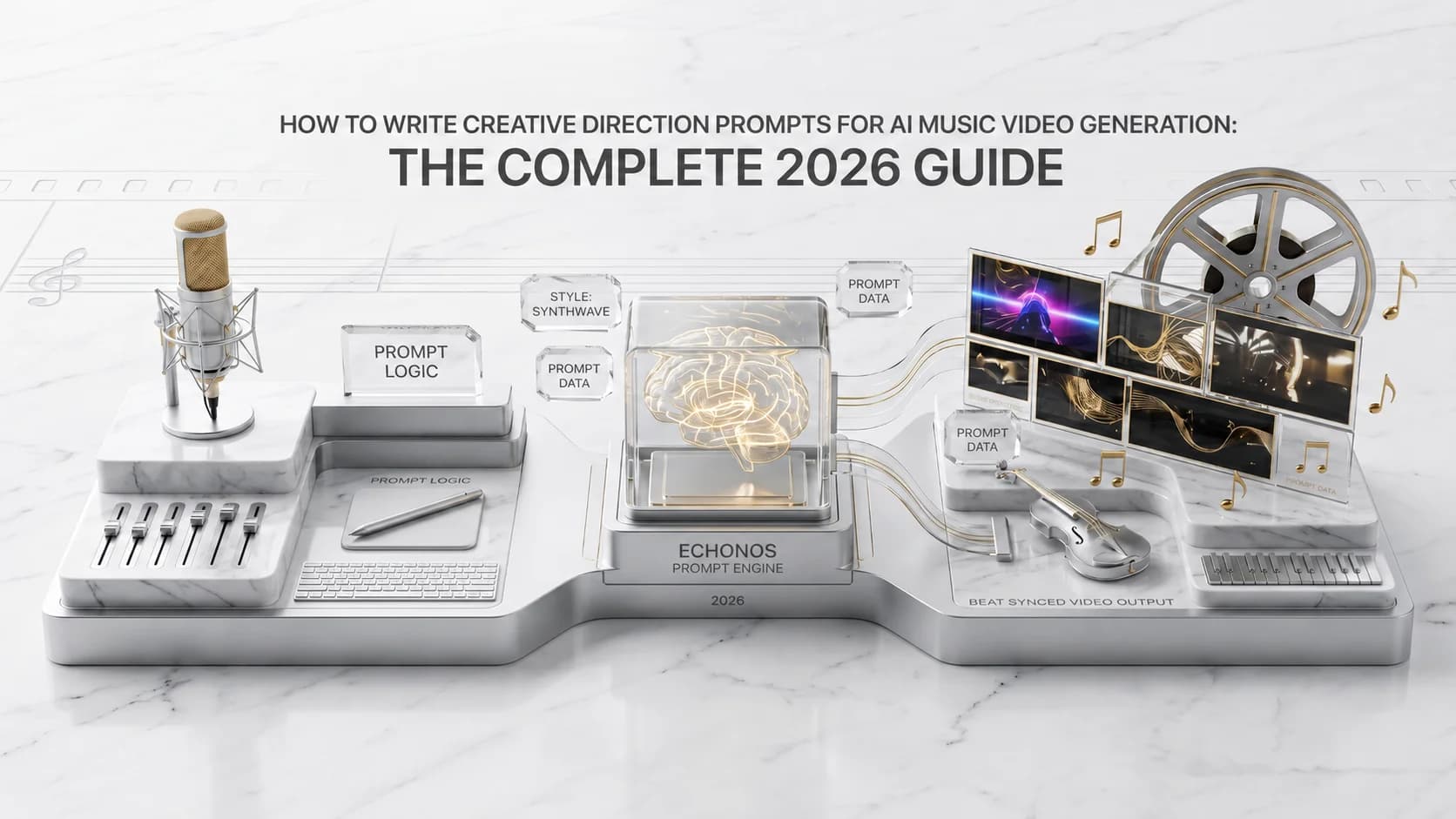
How to Write Creative Direction Prompts for AI Music Video Generation: The Complete 2026 Guide
A working guide to writing creative direction prompts for AI music videos in Echonos Engine. Real examples, the 4 layer prompt anatomy, genre templates, and how to iterate.
Song Release Content Kit: 7 Platform Ready Assets From One AI Music Video in 2026
A song release content kit turns one AI music video into 7 platform ready assets: hero video, Spotify Canvas, lyric video, Shorts, cover art, pre save, and stories.

Written by
Seif Al Sheikh
Chief Operating Officer
Creator of the Tallinja RTT system for the Government of Malta (1M+ downloads, 100K+ daily users) and rebranding lead for OLA Energy across 2,200+ stations. Leads execution operations, B2B enterprise adoption, and financial discipline at Echonos.