

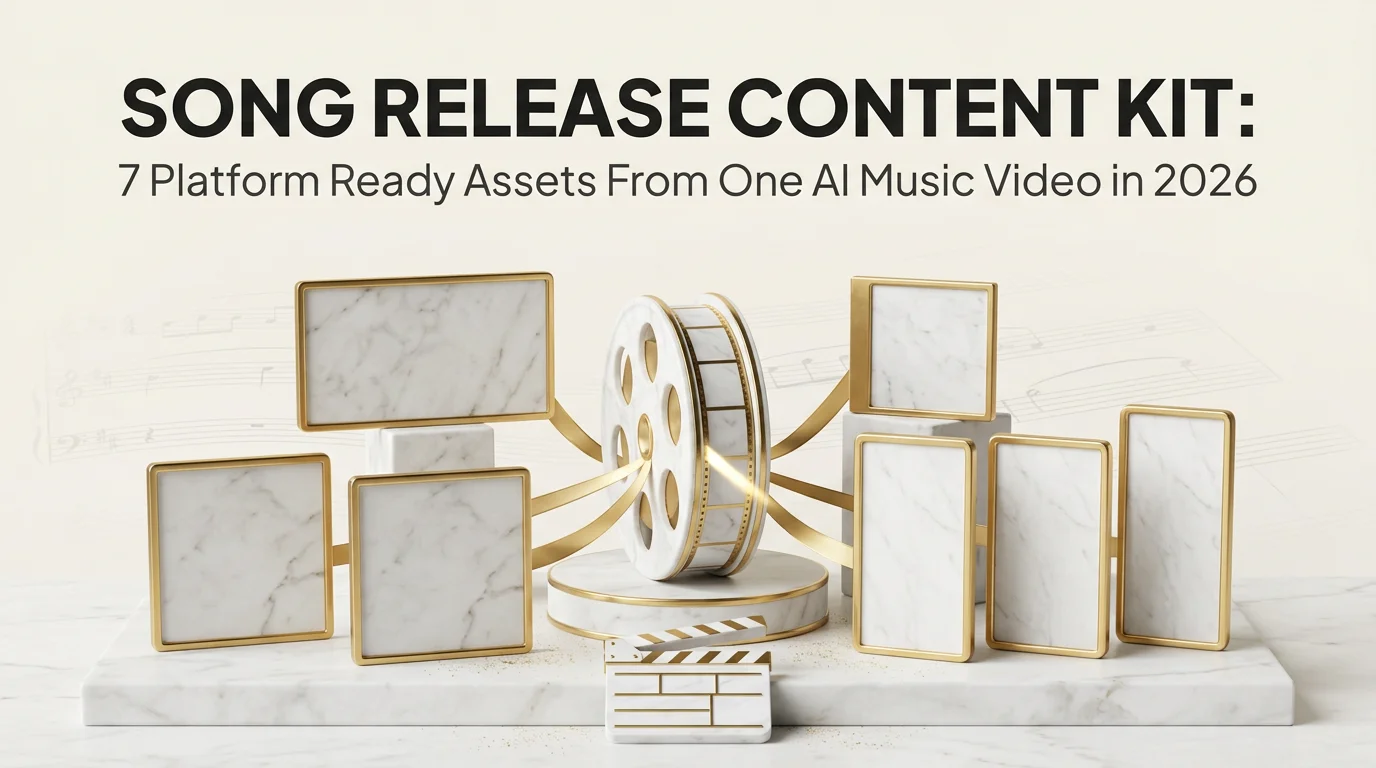
A modern single does not ship as one music video anymore. It ships as a kit of visuals built for streaming, short form, and social, and the artists who treat it that way are pulling ahead of the ones still trying to repurpose a single horizontal MP4 across every platform.
A song release content kit is the bundle of platform-ready visual assets every modern release needs: hero music video, Spotify Canvas (3-8s vertical loop), lyric video, two short-form cuts (Reels/Shorts), 1:1 cover art, pre-save graphic, and profile stories. Echonos covers the core of the kit from one song: music video clips in 9:16, 16:9 or 1:1, plus a Release Package with cover art, Spotify Canvas, and animated cover art.
A song release content kit is the bundle of platform ready visuals an artist or label produces for a single release: the hero music video, a Spotify Canvas loop, a lyric video, YouTube Shorts cuts, the album cover, a pre save visual, and story cards for Instagram and TikTok. Built well, all seven assets share the same visual world.
This guide explains why kits became the release standard, walks through each of the seven assets, and shows how Echonos keeps the cuts in one visual world from one creative direction rather than seven separate briefs. It is written for solo artists, managers, and small labels moving from "one video per single" to a real release system.
What Is a Song Release Content Kit and Why Modern Releases Demand One
A song release content kit is a coordinated bundle of visuals produced for a single track, with each asset cut to the technical specs and viewing behavior of a different platform. Think of it as a film press kit for a song. One creative concept, multiple deliverables, all locked to the same color palette, character, and energy curve.
Five years ago a release was a master file, a cover image, and a music video. That was the entire visual surface a song had to fight on, and the math worked out for one designer plus one director.
Today that surface has fractured. Spotify shows a looping Canvas in the now playing screen on mobile. Apple Music shows animated cover motion on smart displays. YouTube splits between the long form video, Shorts, and the channel banner. Instagram pushes Reels, stories, and a square feed. TikTok wants vertical hooks under 15 seconds. Pre save services need a static graphic that sells the future before the song exists. Each surface sees a different cut, often at a different aspect ratio, and a release that ignores any of them just disappears from it.
The kit is the response to that fragmentation. Instead of producing one asset and hoping it survives the trip across platforms, you plan for the trip up front and produce every cut the release actually needs.
How Streaming, Short Form, and Social Each Need Their Own Cut
Every distribution surface has its own grammar. Streaming rewards atmosphere and looping. A Spotify Canvas plays muted on a phone in someone's pocket; it has 8 seconds to reinforce the song's mood without any audio support, and it loops indefinitely until the listener taps away. Visual treatment that works in a 3 minute hero cut, dramatic builds and big reveals, falls flat in 8 seconds.
Short form is different again. TikTok and Reels viewers swipe in under 2 seconds if the first frame does not earn the scroll. The visual has to land its hook before the listener has heard the chorus.
Social cards are the static layer. Pre save visuals, story cards, and feed posts live in front of the listener weeks before release day, in places that often play silently. Static art has to do work that motion does not.
Treating these surfaces as the same job is what produces the typical indie release: one good music video, a Canvas that is just the cover image looped, a lyric video clearly assembled in a different month with a different aesthetic, and pre save graphics that look nothing like any of it. Listeners notice the incoherence even when they cannot describe it.
The 7 Platform Ready Assets Every Modern Song Release Needs
Across the releases that consistently break out on streaming and short form in 2026, the same seven assets keep showing up. Together they cover every surface a song actually has to fight on, from the streaming app to the Reels feed to the pre save email a fan opens two weeks before release day.
Hero Music Video, Spotify Canvas, Lyric Video, YouTube Shorts, Album Cover, Pre Save Visual, and Story Cards
The hero music video is the long form anchor. The full length visual narrative, usually published to YouTube, that the rest of the kit derives from. It carries the strongest creative direction. Every other cut is a slice or sibling of this one.
The Spotify Canvas is the 8 second vertical loop that plays in the now playing screen on mobile Spotify. Muted by default, looping until the listener taps away. Its only job is to reinforce the song's mood. A good Canvas keeps the listener on the song longer; a bad one gets ignored.
The lyric video is the format short form discovery actually rewards. Modern lyric cuts exist in two or three forms: a vertical loop for TikTok and Reels, a horizontal hero for YouTube, and sometimes a square shape for Instagram. Lyric videos consistently outperform hero music videos on YouTube watch time for hip hop and pop.
YouTube Shorts cuts are the vertical 9:16 clips pulled out of the hero video. The common pattern is one hook clip (first chorus drop), one verse clip, and one bridge clip, each between 9 and 30 seconds. They need to land a hook in the first 1.5 seconds.
The album cover is the static visual that lives everywhere. Streaming tiles, smart speakers, playlist thumbnails, and merch all pull from this one image. It has to read at 64 by 64 pixels on a phone lock screen and at full resolution on a vinyl sleeve. In a kit, the cover shares its visual world with the hero video. If the budget is tight, a free album cover maker can cover this asset, as long as you know what the free plans leave out.
The pre save visual is the marketing graphic for the weeks before the song ships. It carries the announcement on Instagram, in newsletter campaigns, on pre save link landing pages, and on profile banners. It pairs the cover art with copy: release date, artist name, a hook line. Its job is to drive an action (saving the track) before the listener has heard it.
Story cards are the vertical 9:16 graphics for Instagram stories, TikTok stories, and ephemeral release week pushes. A typical kit has three to six: teaser frame, release day frame, lyric quote frame, behind the scenes frame, and one or two reactive frames that respond to listener comments or playlist adds.
Seven assets, four formats (long video, short video, static, motion loop), three aspect ratios that actually matter (9:16, 1:1, 16:9), and one shared creative concept that unifies all of them. That is the kit.
Why Building Each Asset Separately Is the #1 Reason Indie Releases Run Late
Indie releases miss their own deadlines for a single, consistent reason: every asset gets briefed and produced as a separate project. The artist writes a brief for the music video. Two weeks later, on release week, someone realizes there is no Canvas. A different freelancer gets briefed for the Canvas. Another week later the lyric video is briefed, often with a completely different reference deck. By the time the kit is assembled, three different people have made three different aesthetic choices, none of which match the cover art that was finalized months earlier.
This is the post and pray release pattern. It does not happen because the artist does not care. It happens because the tooling assumes one project, one output. There is no place in a traditional pipeline where you brief one concept and get seven coordinated cuts.
The other failure mode is visual incoherence. When seven assets get briefed by seven different processes, listeners can feel the seams. The artist on the cover art does not look like the artist in the music video. The Canvas color palette does not match the Reels cuts. Each asset is fine on its own, but together they read as a stack of unrelated projects, not a release. That incoherence is exactly what algorithms now penalize: smart speaker discovery, playlist tile rendering, and pre save card generation all weight visual consistency.
How Echonos Generates Every Asset From One Concept, Not Seven Briefs
Echonos collapses the seven brief problem into one creative direction. You upload your audio, pick a character, an art style, and any references ("moody rooftop performance, neon rain, cinematic closeups, blue hour city bokeh" is the kind of world you are aiming for), and generate music video clips from the moments of the song you choose. The Release Package then builds the static and loop layer from the same world.
The workflow inside Echonos runs in two places. In Create > Video > Music Video, each run renders a 10 to 30 second clip from the moment of the song you pick, in 9:16, 16:9, or 1:1. Proteon makes a one-shot music video from your song; Orpheon renders a storyboard-driven cinematic cut. Run the chorus, the bridge, and the drop as separate runs and you have your hero footage and your short form cuts. The Release Package produces Cover Art (up to four takes), a Spotify Canvas, Animated Cover Art for Apple Music, and the cover resized for Spotify, YouTube, and Apple Music images.
The two reasons this works are character consistency and a shared art style. Echonos Characters lets you define a persona once and reuse it across every run. The artist on the album cover is the same artist in the Canvas, the Shorts, and the story frames. Picking the same art style and references for every run does the same job for the visual world: lighting, palette, and texture stay consistent without re briefing, which is how artists keep an aesthetic running across an EP cycle.
Audio uploads accept MP3, M4A, WAV, AAC, OGG, and FLAC, up to 40 MB and 60 seconds minimum, which covers every standard streaming master and every reasonable rough mix. Echonos transcribes the lyrics from your upload and uses them, together with the audio analysis, to guide the visuals. Aspect ratio is chosen per run, so you can render 9:16 for Canvas, Shorts, Reels, and story cards, 16:9 for YouTube, and 1:1 for the feed.
If you want to see the surface that runs this, start a release in Echonos Engine with a song you already have. Echonos runs on paid plans with a monthly credit allowance, and a run's credit cost scales with clip length and model, so start with the one moment that matters most, usually the chorus.
How Engine, Storyboard, Characters, and Vault Work Together for a Release Kit
Engine generates the music video clips. It is the audio aware layer that handles beat sync, scene planning, and the actual visual rendering. This is where the kit starts.
Storyboard is the planning layer. You give it one reference frame and nine described beats, it boards them 3x3, and you can use that board for an Orpheon video. When the chorus visual in a run does not hit, you either pick a different moment or settings and run again, or board the shots you want and render them with Orpheon. Fine cuts and sequencing happen in any video editor, such as CapCut, Premiere, or DaVinci Resolve.
Characters holds the persona. Define your on screen identity once, lock the traits that should never change, and apply that character to every release for the next twelve months. This is what stops the artist on the album cover from looking like a different person in the Canvas.
Vault is where the kit lives after it is generated. Audio masters, characters, custom styles, and the finished assets all save to one place. When release #2 ships six weeks later, you do not start from a blank concept; you start from the same character, the same style, and a refined version of the same kit.
Together those four surfaces turn "seven assets, seven briefs" into "one creative direction, a few runs, one Release Package, a quick edit, ship."
A Realistic Timeline From One Idea to Seven Assets in Under a Week
This assumes a finished or near finished audio master and an artist who has already decided their general visual direction. No music video budget, director, or freelance editor.
Day 1, morning. Upload the master. Decide the concept. Pick a character, an art style, and references. Generate the hero moment, usually the chorus.
Day 1, afternoon. Watch the hero with audio at full volume. Note the two or three shots that did not land. If the chorus visual is off, pick a different moment or settings and run again, or board the shots in Storyboard and render them with Orpheon, before you build the rest of the kit around it.
Day 2. Build the kit: run the Release Package for cover art, Spotify Canvas, animated cover art, and resized cover images, then run the verse, bridge, and drop moments in 9:16 for Shorts and story cards. Start the lyric video and pre save base graphic in your editor of choice.
Day 3. Review end to end. Approve the album cover take that reads strongest at small sizes (the streaming tile test: does it still work at 64 by 64?). Lock the Canvas. Pick three Shorts cuts to publish. Rerun anything weak in Create and trim in your video editor.
Day 4. Layer copy onto static assets. The pre save visual gets release date and the hook line. Story cards get teaser, release day, and lyric quote variants.
Day 5. Schedule. Pre save graphic into your marketing flow. Canvas uploaded to Spotify for Artists. Hero video scheduled for YouTube. Shorts queued across the four days following release. Lyric video held for day three as a second wave.
Under a week of working time, no team, no freelancers, kit done.
The Spotify Canvas Layer of Your Release Kit
Spotify Canvas is the most underused asset in indie release kits because most artists treat it as a checkbox. The default Canvas is just the album cover with a slow zoom. Spotify accepts it, but it does no work for the song.
A Canvas that pulls its weight is built like a single 8 second moment from your hero video. One scene, looping, designed to hold attention without sound. The job is mood reinforcement, not narrative. The loop has to feel hypnotic rather than abrupt.
For a deep treatment of Canvas specs, replay psychology, and the streams uplift Spotify has published, see the complete Spotify Canvas maker guide. The short version: vertical 9:16, 8 seconds, loops cleanly, anchored to a single visual hook.
How Canvas Inherits the Same World as Your Hero Music Video
Inside Echonos, the Release Package builds the Canvas as a 4 to 8 second seamless 9:16 loop of your cover art. Describe the cover with the same character and art direction as your music video runs, and the Canvas loop carries that look. If you would rather loop a moment from the hero footage ("isolate the rooftop frame at the chorus drop, hold on the silhouette, slow camera pan"), render that moment in 9:16 and trim the loop in your video editor. Either way you are not designing a Canvas from scratch.
A standalone Canvas project requires a full creative brief. A Canvas derived from your cover or hero video requires one decision: which image or which moment.
The Short Form Layer: YouTube Shorts and Lyric Cuts From One Master
Short form is where releases either find their second life or quietly die at 200 streams. Artists who consistently break out on TikTok and Reels publish 10 to 30 short cuts in the first month, not one. The kit makes that volume possible because every cut shares one creative direction, not a fresh production. In Echonos each moment below is its own 10 to 30 second run in 9:16, using the same character and art style as the hero.
The most reliable moments to cut:
The first chorus hook as a 9 to 15 second vertical clip. This usually performs best on TikTok and Reels. Lead with the chorus, not the intro.
The bridge moment as a quieter 9 to 12 second clip. Useful for lyric quote overlays and reaction friendly content.
The drop or beat switch as a 6 to 9 second clip. Built for a single feeling, not a story.
A second chorus or outro hook for week two and three reposts. Pulled the same way as the first chorus but from a different timestamp.
For the deeper format breakdown, including hook placement, caption sync, and which lyric video shapes work on which platform, see the free lyric video maker guide.
The lyric video itself usually ships in two cuts. The vertical lyric loop runs as a TikTok and Reels post. The horizontal lyric hero gets uploaded to YouTube as the song's secondary video, often outperforming the hero music video on watch time for genres where listeners want to read along. Echonos does not add lyric text, so set the words in your video editor over footage from your Echonos runs, and both cuts keep the hero's character and palette.
For the full set of post release cuts you should plan, including reaction friendly loops and countdown stories, see the music promo video and Reels playbook.
The Static Layer: Album Cover, Pre Save Image, and Profile Visuals
Static assets are the most overlooked piece of a release kit because they look simple. They are not. The album cover does more work than any video in the kit because it lives on every surface forever: smart speaker tiles, playlist art when the song gets added years later, lock screen previews, share cards when listeners DM the song to a friend.
The album cover has to read at 64 by 64 pixels and at full resolution at the same time. It has to suggest the genre without resorting to costume. It has to belong in the same world as the hero video without being a screen grab from it. In Echonos the cover is generated in the Release Package, with up to four takes to compare, so you pick the one that reads strongest at small sizes before approving.
For the deeper treatment of what cover design has to do in 2026, including genre conventions and the four jobs every modern cover handles at once, see the AI album cover guide for 2026.
The pre save visual sits between the album cover and the marketing graphic. It usually combines cover art with copy (release date, hook line, artist handle) and works as the announcement card across Instagram posts, newsletter sends, pre save service landing pages, and profile banners. The strongest pre save visuals look like the cover art got promoted to a campaign.
Profile visuals do not have to ship with every single, but they have to evolve with album cycles. When you reuse the kit's character and palette across all of these surfaces, the artist's profile reads as a coherent brand instead of a collage of unrelated visual choices.
Song release content kit checklist (7 assets, 1 page)
Use this as a pre-publish checklist for every single release. Each asset maps to a platform surface.
| Asset | Platform surface | Spec | Status |
|---|---|---|---|
| Hero music video | YouTube, artist site | 9:16 vertical or 16:9 horizontal, full song length | n/a |
| Spotify Canvas | Spotify Now Playing screen | 9:16, 3-8 seconds, MP4, no audio, under 25 MB | n/a |
| Lyric video | YouTube search, TikTok audio use | Horizontal 16:9 or vertical 9:16, full song length, caption sync | n/a |
| Short-form cut 1 (hook reel) | TikTok, Reels | 9:16, 15-30 seconds, leads with hook | n/a |
| Short-form cut 2 (drop clip) | YouTube Shorts | 9:16, up to 60 seconds, audio bookmarked | n/a |
| Cover art | Streaming platforms, playlists | 3000×3000 px, JPEG or PNG | n/a |
| Pre-save / release graphic | Instagram, Stories | 1:1 or 9:16, date and title visible, artist handle | n/a |
Most of these come from one Echonos creative direction. Music video runs supply the hero footage, the hook reel, the drop clip, and the footage under the lyric video; the Release Package supplies the cover art and Canvas loop. Full song length cuts come with Long Form Export on higher plans, or you can sequence several runs in your editor. The 21-day release timeline maps when each asset ships during the pre-release and post-release cycle. For storing and reusing the assets across future releases, the Echonos Vault guide covers the organization workflow.
Three related guides fill in the pieces of the kit: the AI album cover generator guide for the artwork, the lo fi visualizer guide for the loop style that dominates study and chill playlists, and the Kaiber alternatives comparison if you are still picking the engine that produces the master.
FAQ
Frequently Asked Questions About Song Release Content Kits
5 questions answered. Tap to expand.
Do I Need All 7 Assets for Every Single?
Do I Need All 7 Assets for Every Single?
Practically, no. The non negotiables for any modern release are the album cover, the Spotify Canvas, and at least two short form cuts. Without those three, the song is invisible on the surfaces where listeners actually find new music.
The hero music video and the lyric video are high return additions when the song has a strong visual concept or strong lyrics, respectively. The pre save visual and story cards are release week multipliers; they are not strictly required if you have no marketing flow to push them through, but the moment you do, they become the difference between a single that announces itself and a single that drops silently.
For a debut single from a new artist, the cover, the Canvas, the hero video, and three Shorts cuts are usually enough. For a flagship single from an established artist or a single with editorial ambition, all seven matter, and skipping any of them leaves a surface uncovered.
Can I Reuse a Release Kit Across an Album Cycle?
Can I Reuse a Release Kit Across an Album Cycle?
Yes, and this is where the kit pays compounding returns. The character you build for single #1 carries through every single in the cycle. The style you lock for single #1 becomes the visual signature of the whole album. Pre save templates, story card layouts, and lyric video formats save and reuse with new audio and new copy.
What changes per release is the audio, the per tile concept, and small palette shifts that mark each single as its own moment. What stays the same is the artist character, the broad style, and the workflow.
The honest math: single #1 takes four to five days from scratch. Single #2 takes roughly half that, because Vault is already populated. By single #4 the per release time drops again. Kits are the single best lever an artist has against release fatigue.
How Do Release Kits Work for an Artist Without a Manager or Designer?
How Do Release Kits Work for an Artist Without a Manager or Designer?
This is the workflow they were built for. Solo artists and bedroom producers without a team are the audience that benefits most from collapsing seven briefs into one concept, because they are the artists who would otherwise skip half the assets or burn out producing them.
The realistic solo artist flow: write the song, finish the master, upload to Echonos, decide one concept, generate the hero moment, rerun anything weak, run the Release Package and the short form moments, trim in a video editor, layer copy on the static assets in any image editor, schedule. The biggest skill required is not design or motion graphics; it is taste. That kind of editorial judgment is what solo artists already use to pick mixes and masters.
If you want to start a kit on a song you already have finished, open the release surface in Echonos and run the first concept. Echonos runs on paid plans with a monthly credit allowance, and a run's credit cost scales with clip length and model, so a single chorus run is a cheap way to see whether the kit workflow fits your release plan.
What assets do I need for a music release?
What assets do I need for a music release?
A modern release needs at minimum: a hero music video or lyric video for YouTube, a Spotify Canvas for the Now Playing screen, at least one short-form vertical clip for TikTok or Reels, and cover art for streaming platforms. A complete release kit also includes a pre-save graphic, a YouTube Shorts cut, and a profile story tile. With Echonos, one creative direction covers the core of the kit: music video runs in 9:16, 16:9, or 1:1 for the hero and short-form clips, and the Release Package for cover art and the Canvas, all sharing the same character and art style.
How many visuals does a music release need?
How many visuals does a music release need?
A minimum viable release needs three visuals: a hero video, a Spotify Canvas, and one short-form clip. A full release kit needs seven: hero video, Canvas, lyric video, two short-form cuts (one for TikTok/Reels, one for YouTube Shorts), cover art, and a pre-save graphic. Artists releasing on a regular monthly cadence typically aim for the seven-asset kit for priority singles and the three-asset minimum for deep cuts and B-sides.
Keep reading
Related Articles
Spotify Canvas Maker Guide: Specs, Best Practices, and the Streams Boost in 2026
Spotify Canvas maker guide: 9:16 specs, the 3 to 8 second length, free ways to make one, why uploads get rejected, and what Spotify says it does for streams.
Free Lyric Video Maker: What Free Actually Costs You in Time and Quality
A guide to free lyric video makers: where each one caps you, how long manual lyric timing takes, the cuts each platform wants, and when paying saves money.
AI Album Cover Generator: What Makes a Cover Actually Work in 2026
AI album cover generators compared: 6 tools by type, free option and release workflow, plus DSP artwork rules, the best free picks and the copyright question.

Written by
Syed Ali
Founder & CEO
Former COO at Tabler App (1M+ users, $50K+ MRR, successful exit) and Data Science Consultant at Deloitte, Booz Allen Hamilton, and Accenture. Leads capital markets, investor relations, and corporate strategy at Echonos.