

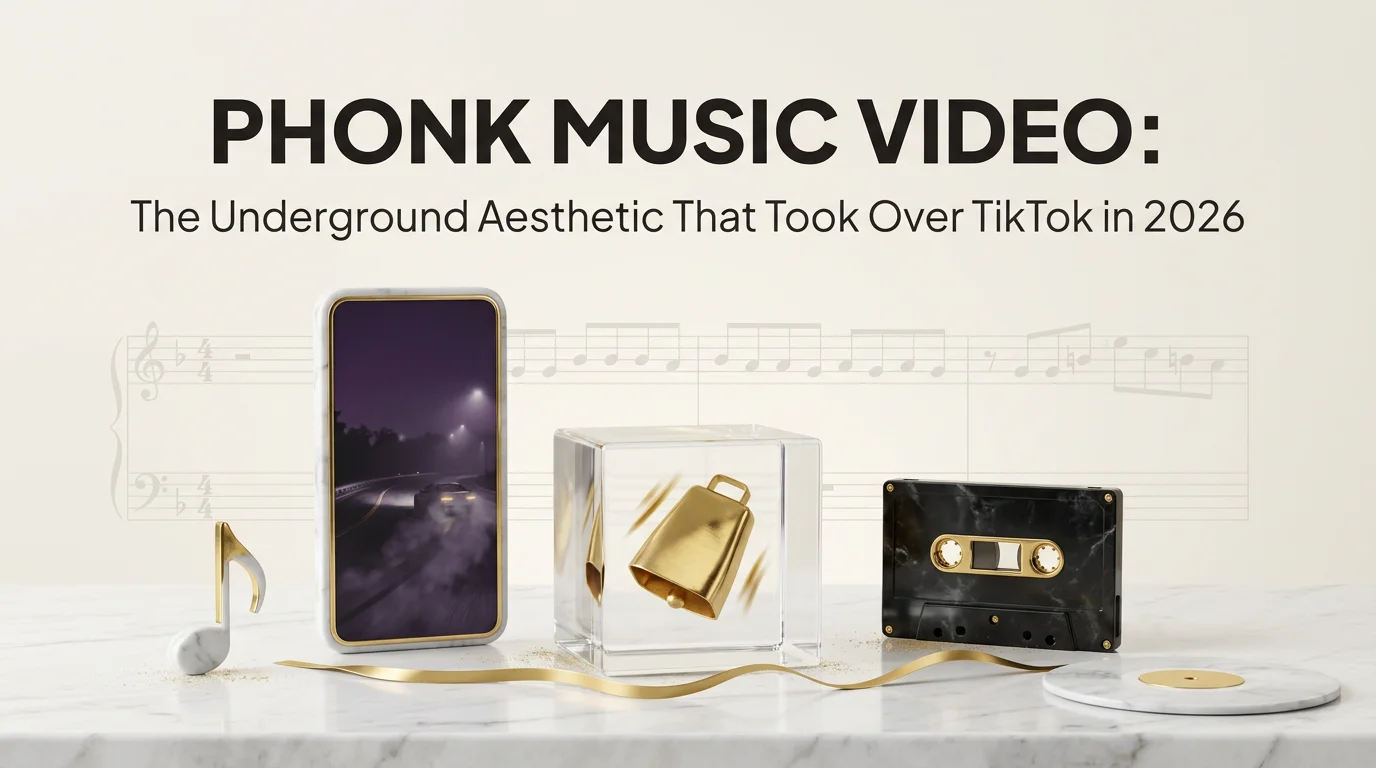
A phonk music video is the visual half of a subgenre that started as a 90s Memphis rap homage on SoundCloud, mutated into drift phonk through the connection with Russian and Eastern European drift car culture, and now exists across multiple visual dialects. The most common phonk music video in 2026 is the drift phonk video: cars in controlled slides, masked figures behind the wheel, grainy filtered footage, evil-face logos, red and black color palette. But phonk has other dialects too, and producing a video that reads as authentic phonk means picking the right one for your track.
The shortest path to a phonk music video: identify which phonk subgenre your track sits in (drift phonk, house phonk, atmospheric phonk, or original Memphis-style phonk), match the visual codes for that subgenre, and produce the video with AI generation that handles the stylized aesthetic well. The rest of this guide covers the phonk subgenres and their visual codes, the drift culture connection that shaped the dominant aesthetic, and how to produce a phonk music video without filming actual drift footage.
Key Takeaways
- Phonk has multiple subgenres with different visual conventions. Drift phonk dominates 2026 because of the connection to drift car culture and TikTok visual trends.
- The drift phonk aesthetic: drift cars (usually 90s Japanese or older European tuner builds), masked or hooded drivers, grainy VHS filter, red and black palette, evil-face logos, motion blur on the car at full slide angle.
- Original Memphis-style phonk has different codes: 90s Memphis rap imagery, low-fi photo aesthetic, religious or occult symbolism, slower energy, sepia or near-monochrome treatment.
- The grainy lo-fi filter is universal across phonk subgenres. Polished clean footage breaks the genre signal.
- Phonk works well with AI music video generation because the aesthetic is stylized rather than dependent on photorealistic detail.
The Phonk Subgenres and Their Visual Codes
"Phonk" is the umbrella. Three distinct subgenres have emerged.
Drift Phonk (Dominant 2026 Aesthetic)
The version most people mean when they search "phonk music video" in 2026. Born from the connection between phonk's heavy bass and Eastern European drift car culture, the visual conventions are extremely codified.
Visual codes:
- 90s Japanese tuner cars (Toyota Supra, Nissan Skyline, Mazda RX-7, Toyota AE86) or 80s European builds (BMW E30, BMW E36, Mercedes 190E) at full drift slide angles
- Masked or hooded drivers (balaclavas, hoodies, occasionally specific anime masks)
- Grainy VHS filter with visible scan lines and chromatic aberration
- Red and black dominant palette, occasionally with yellow accent for caution-tape effects
- Evil-face logos (skulls, demon faces, occult-style emblems)
- Night-dominant settings: empty highways, underground parking structures, deserted industrial zones
- Heavy motion blur, tire smoke, occasional sparks from car body contact with curbs
House Phonk and Atmospheric Phonk
Slower, more atmospheric subgenres of phonk. Less drift-focused, more dance-floor or contemplative.
Visual codes:
- Atmospheric environments (urban night, rain, fog)
- Lower contrast than drift phonk
- Cooler palette (deep purples, blues, occasional teal)
- Single character framings rather than car-focused
- Slow camera movement instead of motion blur
Original Memphis-Style Phonk
The original 90s-Memphis-inspired phonk that started the genre on SoundCloud in the mid-2010s. Less mainstream than drift phonk but still has an audience.
Visual codes:
- 90s Memphis rap aesthetic references
- Low-fi photo treatment, occasionally near-monochrome
- Religious or occult symbolism (crosses, candles, smoke)
- Sepia tones, dust, film damage effects
- Slower energy, often static or near-static scenes
- Older mics, cassette tapes, period-correct technology
Picking the right subgenre for your track is the load-bearing decision. Drift phonk visuals on an atmospheric phonk track creates immediate genre confusion.
Why Drift Phonk Dominates the Visual Aesthetic
Drift phonk's visual dominance has specific causes worth understanding because they shape what the audience expects.
The drift car footage trend on TikTok in 2020 to 2022 paired with the rise of phonk's bass-heavy production created a feedback loop. Drift footage paired with phonk performed well; this normalized the pairing. Now the audience associates phonk with drift even when the original track was not produced for that visual context.
Russian and Eastern European drift culture carried the early adoption. Specific channels (NFS Phonk, Phonk Junkie, others) curated drift videos set to phonk tracks for global audiences, building the visual language as the genre grew.
The aesthetic is easy to imitate. Drift phonk's visual codes are graphic and stylized rather than naturalistic. A creator with limited filming access can produce content that reads as drift phonk through filtering and stock drift footage layered with the right text overlays.
The result: in 2026, "phonk music video" is read by most audiences as drift phonk unless explicitly framed otherwise.
Producing a Drift Phonk Music Video From Your Track
The workflow:
- Confirm the subgenre. If your track is drift phonk or a phonk variant that suits the drift aesthetic, proceed with drift visuals. If it is atmospheric or Memphis-style, use the codes for those instead.
- Write the creative direction with drift phonk codes named. Example: "Drift phonk aesthetic. 90s Japanese tuner car (Toyota Supra-style silhouette, not exact model) in mid-drift on a wet empty highway at night. Masked driver visible through windshield. Red and black palette dominant. Grainy VHS filter throughout, visible scan lines, slight chromatic aberration at frame edges. Motion blur on the car, tire smoke trailing. Sodium-vapor streetlights as occasional warm accents in a cold-dominant scene."
- Pick the closest art style. Echonos art styles such as Film Noir, Cyberpunk, or PS2 Game Cinematic get the dark, stylized base close. Combined with the creative direction (and references that show the grain), this produces native phonk visuals; add a filter pass in post if the grain needs more weight.
- Upload your track. MP3, M4A, WAV, AAC, OGG, or FLAC, up to 40 MB, 60 second minimum. Phonk tracks typically run 1.5 to 3 minutes, and each run renders 10 to 30 seconds from the moment you pick, so start with the drop.
- Generate the vertical 9:16 first draft. Minutes, not hours. Pick 16:9 on a separate run if YouTube is the main target.
- Iterate scenes that drifted from the aesthetic. Phonk is detail-sensitive; if the filter quality slips or the car styling pulls out of period, run that moment again in Create.
The music video in 5 minutes walkthrough covers the engine flow. The prompt writing guide covers iteration on specific scenes.
The Grain Filter: Why It Is Non-Negotiable
A phonk video without the grainy lo-fi filter does not read as phonk. The filter is one of the strongest single visual signals in the genre.
The filter typically includes:
- Visible scan lines (horizontal banding suggesting analog video)
- Chromatic aberration at edges (red and blue fringing on high-contrast lines)
- Film grain (textured noise overlaid on the image)
- Slight dust and damage suggestions
- Occasional tracking glitches (sudden vertical line breaks or moments of frame instability)
In AI generation, these are produced by either calling out the filter explicitly in the prompt ("grainy VHS filter with scan lines, chromatic aberration, light dust") or by selecting a preset that includes the filter as part of its style.
Polished clean output breaks the genre. If the AI generates scenes that look high-quality and clean, add the filter explicitly in the prompt or do a post-production filter pass before release.
Character Consistency in Phonk Videos
Many phonk videos feature recurring characters (the driver, the figure observing from the side of the road, the crew posing with the car). For the drift subgenre especially, the masked or hooded character recurring across scenes is part of the visual identity.
The character consistency guide covers the locking pattern for maintaining a character across scenes. For phonk specifically: lock the mask or hood detail (specific type, specific color, specific style), lock the silhouette (long jacket, harness, specific clothing), and reference the character with the same physical description in every scene prompt.
If the driver looks like five different masked figures across the video, the genre identity weakens.
Phonk Music Video Specs for Release
Same vertical short-form specs as any music release.
- 9:16 vertical, 1080 by 1920 for the master and short-form cuts.
- 15 to 60 seconds for cut-downs. Phonk's high visual energy supports the longer end of this band; viewers stay through 25 to 30 second cuts well.
- Hook in the first 3 seconds. Lead with the most phonk-readable frame: a car at full drift angle, a masked driver close-up, a wide highway shot with the car in the distance.
- 16:9 horizontal version for YouTube if YouTube is a primary distribution target for the genre, which it often is given the strong YouTube phonk-channel ecosystem.
Common Phonk Music Video Mistakes
Clean polished output. Breaks the lo-fi genre signal. The filter is mandatory.
Modern cars instead of 90s tuner builds. Drift phonk specifically references a period and a car culture. A 2023 EV in a drift phonk video reads as wrong, even if the drift footage is technically excellent.
Bright daytime settings. Phonk is overwhelmingly night-dominant. Daytime scenes work for brief contrast but should not dominate.
Crowd scenes. Phonk's visual identity centers on a single driver or small crew. Crowded scenes break the genre.
No evil-face or occult-style logo somewhere in the video. Optional but expected. Many phonk videos include the producer's or artist's logo with the genre-typical iconography. Skipping it does not break the video but it omits a recognizable signal.
The Read on Phonk Music Videos
Phonk has clear visual codes that depend on which subgenre your track sits in. Drift phonk dominates 2026's mainstream phonk aesthetic with its drift car visuals, masked drivers, grainy VHS filter, and red-black palette. House phonk and atmospheric phonk soften the codes. Original Memphis-style phonk carries different conventions tied to 90s Memphis rap aesthetics. Picking the right subgenre is the load-bearing decision.
If you are producing a phonk track and want the video to come together fast in the right subgenre aesthetic, Echonos Engine accepts the subgenre-specific creative direction and produces a 9:16 first draft (or 16:9 for YouTube) in minutes, not hours, with the consistency tooling needed to keep the masked-driver and tuner-car visual identity stable across every scene.
FAQ
Frequently Asked Questions
5 questions answered. Tap to expand.
What is the difference between drift phonk and regular phonk?
What is the difference between drift phonk and regular phonk?
Drift phonk is a subgenre of phonk that pairs heavy bass and aggressive synths with the visual world of drift car culture. Regular phonk (often called Memphis phonk or just phonk) traces back to 90s Memphis rap and has a slower, lo-fi, more atmospheric character. Drift phonk dominates 2026's mainstream phonk aesthetic; original Memphis phonk has a smaller but loyal audience.
What cars are used in drift phonk videos?
What cars are used in drift phonk videos?
Most commonly 90s Japanese tuner cars: Toyota Supra (especially the A80), Nissan Skyline (R32, R33, R34), Mazda RX-7 (FD3S), Toyota AE86, Nissan Silvia (S13, S14, S15). European alternatives include the BMW E30, BMW E36, and Mercedes 190E. The aesthetic centers on cars from roughly 1985 to 2002 with specific tuner-culture modifications.
Why does every phonk music video have a grainy filter?
Why does every phonk music video have a grainy filter?
The grainy VHS filter is one of the strongest single genre signals in phonk. It carries the lo-fi heritage of the original Memphis phonk sound and ties the visual to analog-video aesthetics that match the genre's audio character. A polished clean phonk video breaks the genre identity; the filter is functionally mandatory.
Can I make a phonk music video without using actual drift footage?
Can I make a phonk music video without using actual drift footage?
Yes. AI music video generation produces drift phonk visuals from creative direction without requiring real drift footage. The aesthetic codes (cars in mid-slide, masked drivers, grainy filter, red and black palette) can be specified in the prompt and generated as original scenes. For artists without access to real drift footage, this is the standard production path in 2026.
What color palette is used in phonk music videos?
What color palette is used in phonk music videos?
Red and black dominant for drift phonk, with occasional yellow accents (caution-tape style). Deeper purple and blue tones for atmospheric phonk and house phonk. Sepia and near-monochrome for original Memphis-style phonk. The palette is consistently high-contrast and dark.
Keep reading
Related Articles
How to Write Creative Direction Prompts for AI Music Video Generation: The Complete 2026 Guide
How to write AI music video prompts in 2026: the 4-layer director brief, copy-paste genre templates, and how to control style, lighting, and motion.

Music Video in 5 Minutes: An Echonos Engine Walkthrough From Idea to First Draft
How to make an AI music video step by step in Echonos: upload your song, write a brief, and render a 10–30s beat-synced clip in 9:16, 16:9, or 1:1.

Character Consistency in AI Music Videos: Why It Is the Foundation of Your Artist Brand in 2026
How character consistency works in AI music videos: keeping the same face, outfit, and visual identity stable across every scene and release.

Written by
Hari DevanathanLead Backend Engineer
Ex-Microsoft and Senior AI/Cloud Engineer at Leidos, building NLP, OCR, vector search, and LLM pipelines that generated ~$20M annually. Owns Echonos' audio intelligence and black-box generation pipeline, including audio analysis, beat detection, and GCP infrastructure.