

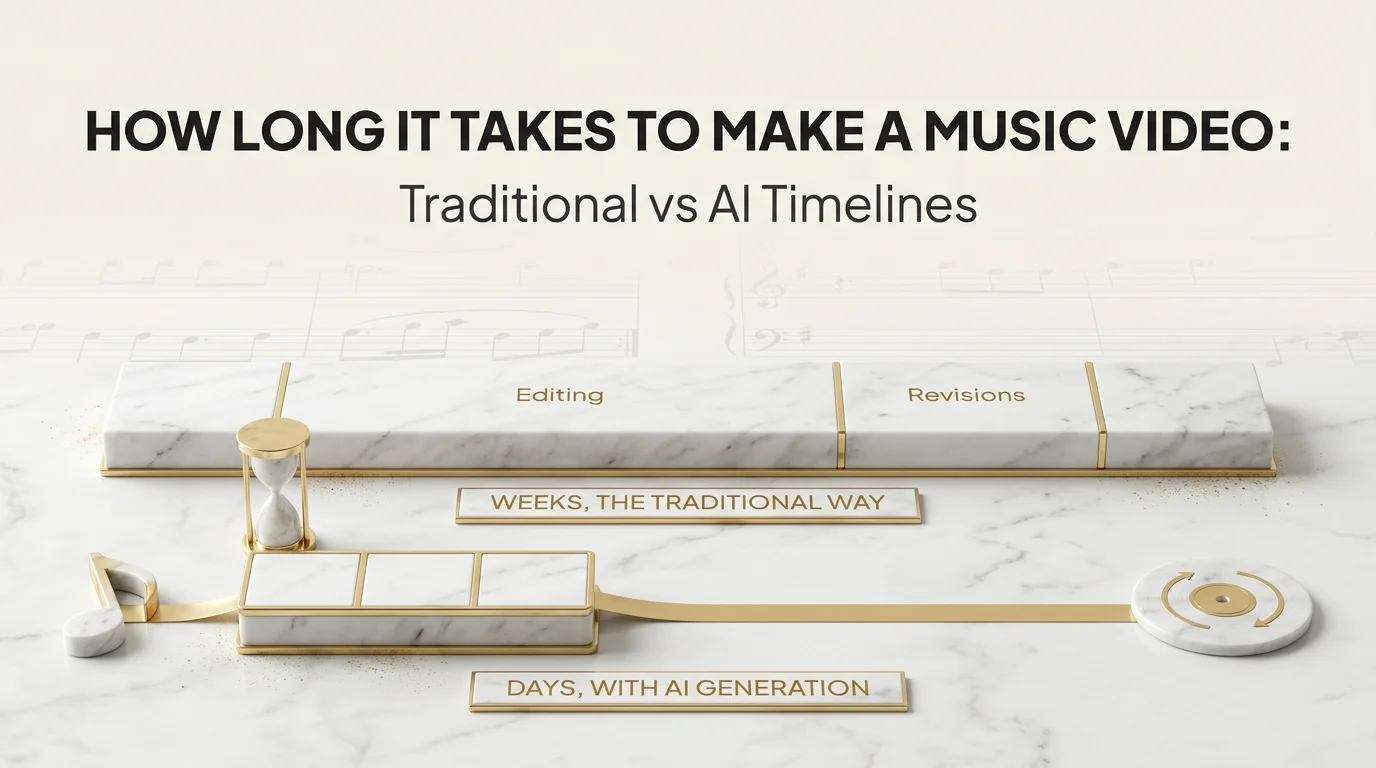
A traditionally produced music video takes two to six weeks from concept to finished file: roughly a week of planning, a day or two of shooting, and one to three weeks of editing and revisions. An AI-generated video compresses most of that into hours to a few days, because there's no scheduling, no location logistics, and no waiting on an edit bay to open up.
That gap matters more than it sounds like on paper. A traditional timeline forces the video decision weeks before a release date, often before the final mix is even locked. A compressed timeline means the video can happen after the song is finished, which changes how much of the release calendar the video actually eats.
Key takeaways:
- A traditional music video timeline runs two to six weeks, with editing and revisions taking up the largest single share of that time, not the shoot itself.
- Most of the traditional timeline is scheduling and logistics, not creative work: crew availability, location permits, and edit-suite time.
- AI generation compresses production to hours or days by removing scheduling dependencies entirely.
- A realistic same-week release plan is achievable with AI generation but still needs a few days of buffer for revisions.
- Some parts of the process still take human time regardless of tool: the concept decision, final creative approval, and platform-specific cuts.
The traditional music video timeline
A traditional shoot-based music video typically breaks into four phases. Pre-production (treatment, location scouting, casting, crew booking, budget approval) usually takes five to ten business days for an independent-budget video, longer for anything with multiple locations or a larger crew. The shoot itself is often just one or two days, sometimes a single long day, which surprises artists who expect the shoot to be the biggest time sink. Post-production (editing, color grading, visual effects if any, sound sync) is the phase that actually eats the most calendar time, usually one to three weeks depending on how many revision rounds the artist and any label stakeholders want. And distribution prep (exporting for YouTube, cutting down for social formats, uploading, scheduling) adds another few days on top.
Add it up and a modest independent video runs three to four weeks from a locked concept to a finished, distributable file. A video with more complex effects, multiple locations, or more revision rounds can stretch past six weeks without anything going wrong; that's just the normal cost of coordinating people and schedules.
Where the weeks actually go
The honest answer is that most of the traditional timeline isn't creative work, it's logistics. Finding a crew that's free on the same days the artist and any locations are also available. Waiting on location permits or venue approvals. Scheduling an editor's time, which is often the single longest wait in the whole process since editors work multiple projects at once and a video can sit in a queue for days between revision rounds.
Revisions specifically deserve their own mention, because they're usually underestimated. A first cut rarely matches everyone's mental image of the treatment exactly, and each round of "change this transition, extend this shot, recolor this section" adds calendar days even when the actual editing work involved is measured in hours. Three rounds of revisions with a day or two of turnaround each is a common, unremarkable pattern, and it alone can account for a week of the total timeline.
How AI generation compresses production
AI-generated video removes the two biggest time sinks in that traditional breakdown: crew scheduling and edit-queue waiting. Echonos Engine generates an audio-analyzed music video directly from an uploaded song (10 to 30 seconds per run from the moment you pick, with Long Form Export on higher plans for longer cuts), with generation itself measured in minutes, not hours, once a concept and any character or style setup are in place. There's no location to book, no crew to coordinate, and no separate edit-suite queue to wait on for a first cut.
That doesn't mean the whole process collapses to the length of a single generation. Testing a concept means generating, watching it back against the treatment, and often running specific moments again rather than redoing the whole video. That is what makes revisions fast: a pacing problem in one section or a scene that didn't land means running that moment again in Create with different settings (or planning it shot by shot with Storyboard and Orpheon), with fine cuts handled in any editor such as CapCut, Premiere, or DaVinci Resolve, rather than regenerating everything.
The realistic compressed timeline looks like: a day for the treatment and concept (see what makes a good music video for what that concept actually needs to cover), a first full generation the same day or the next, one to two days of watching the result and running specific moments that need adjustment again, and a final day for platform-specific exports. That's three to five days total for a video that would have taken three to six weeks the traditional way, and the biggest single variable in that range is how many rounds of scene-level revision the artist wants, not how long any individual generation takes.
A realistic same-week release plan
For an artist working toward a release date with the song already locked, a same-week video timeline is achievable but still needs buffer, not zero slack. Day one: write the treatment (concept, look, pacing notes, character direction, rough scene list). Day two: set up any character or style assets in Vault, then run the first generation. Day three: review against the treatment, flag scenes that need fixing. Day four: run the flagged moments again in Create rather than redoing the whole video. Day five: export cuts for each platform the release needs (the main video plus any shorter vertical cuts, with 9:16, 16:9, or 1:1 chosen per run) and do a final pass check.
That five-day plan has real slack built in, because the review-and-regenerate step (day three to four) is where most of the actual decision-making happens, and rushing it defeats the purpose of having a fast generation step in the first place. Music video in 5 minutes: the Engine walkthrough covers the mechanics of that first generation pass in more detail, and the 21-day release week visual timeline covers how the video fits into the full set of release assets and dates around it, not just the video in isolation.
Where a compressed timeline still needs buffer
The biggest planning mistake with a fast generation workflow is treating "the tool is fast" as "the whole process is instant." Generation speed compresses the mechanical bottleneck (crew, scheduling, edit queues), but it doesn't compress the decision-making that has to happen around it. An artist who writes the treatment the same day as the release, generates once, and ships whatever comes back without reviewing it against the original concept is skipping the step that actually determines quality, not just saving time on it.
The realistic buffer to build in: a day for the treatment to actually be thought through rather than rushed, and at least one full review-and-regenerate cycle between the first pass and calling the video finished. That buffer is what separates "fast" from "fast and good." A five-day compressed timeline with a real review day in the middle consistently outperforms a two-day timeline that skips review entirely, even though both are dramatically faster than a traditional shoot.
What still takes human time
Speed of generation doesn't remove the parts of the process that were never really about production time. Deciding the concept still takes the same thinking it always did, whether that thinking happens over a week of pre-production meetings or in a single focused sitting the day before generating. Final creative approval (does this actually represent the song, does the artist feel right about it) is still a human judgment call regardless of how fast the technical production happened. And cutting a full video down into platform-specific formats (a vertical short, a Canvas loop, a thumbnail) still takes a deliberate pass per platform, even if each individual cut is fast to produce. Iterating on an AI-generated music video covers that review-and-refine step in more detail, since it's usually the part of a compressed timeline that determines whether the final video actually lands or just arrived quickly.
Planning backward from a release date
A useful way to apply this timeline in practice is to work backward from a fixed release date rather than forward from "whenever the video gets started." If the release date is locked and the song is finished, count backward: a day for final exports and platform-specific cuts, one to two days for scene-level revisions, a day for the first generation and initial review, and a day for the treatment itself. That puts the video's start point roughly four to five days before release, which is a realistic minimum for most independent artists using a fast generation workflow, versus the three to six weeks the same backward count would require for a traditional shoot-based production.
This backward-planning approach also surfaces a common scheduling mistake: artists who lock a release date, then treat the video as something to fit in "whenever there's time" without ever actually counting the days needed. A treatment written the day before release, with no time left for a review-and-fix pass, tends to produce a weaker video than the same concept given even two extra days of buffer, not because the tool is slower, but because the human review step got skipped under time pressure.
Keep reading
Related Articles

What Makes a Good Music Video: The Elements That Actually Hold Attention
What makes a good music video comes down to five repeatable elements: concept, visual consistency, beat-locked pacing, palette, and hook framing.

Music Video in 5 Minutes: An Echonos Engine Walkthrough From Idea to First Draft
How to make an AI music video step by step in Echonos: upload your song, write a brief, and render a 10–30s beat-synced clip in 9:16, 16:9, or 1:1.
21 Day Release Week Visual Production Timeline: A Working Plan for Modern Artists and Labels in 2026
A day-by-day 21-day visual release calendar for indie artists: when to ship cover art, Spotify Canvas, Reels, Shorts, and your hero music video.

Written by
Brandon GrossnickleFounder & CTO
Former Senior Data Scientist at Deloitte, contracted for U.S. Government programs and Walmart. Indie iOS developer with 7 apps on the App Store. Leads Echonos' core technology architecture, product strategy, and infrastructure scaling.